By Eugenie Santiago
The plot of No Country for Old Men follows a hard-edged West Texas welder and Vietnam veteran who discovers a drug deal gone wrong and a satchel of cash. He must evade a relentless hitman hunting the money to survive and keep his wife safe.
The film's thematic question is simple: is control real, or is it an illusion?
Its answer is bleak. Once events are set in motion, control is an illusion. The only meaningful choice left is whether to accept that and respond to what's already there without self-deception. In the characters' own words, you can't control what's coming.
That truth is dramatised through two arcs a protagonist on a negative arc, and a deuteragonist on a positive (though bleak) one. Together, they show the cost of clinging to control, and the strange coherence that comes from letting it go. It's a story about choice, consequence, and what happens when the world refuses to negotiate.
In practice, the tension shows up as a fight between free will and determinism.
Free Will vs. Determinism
Free Will
Free will is the belief that our choices genuinely shape what happens to us and in the world around us. It assumes that decisions matter, that actions lead to consequences, and that good judgement can prevent some bad outcomes. It does not claim that everything is controllable. It claims there is enough control for life to feel meaningful.
It's an appealing belief because it gives daily life structure and meaning. It gives us a sense that the future is to a great extent negotiable and it makes planning feel worthwhile.
Determinism
Determinism holds that events unfold according to forces beyond individual control, regardless of intention or effort. Outcomes are shaped by circumstance and chance. We still experience the act of choosing, but those choices are links in a chain rather than independent acts of will.
Determinism doesn't deny that people make decisions. It questions whether those decisions have the power we assume they do. In this frame, planning doesn't guarantee safety, intelligence doesn't ensure survival, and morality doesn't organise outcomes. Life becomes less a story we author and more a sequence we move through.
The tension between these two values exists because both feel true in different ways. We experience ourselves as choosing, but those choices don't necessarily lead to desired or expected outcomes. We feel like the authors of our lives, but the world often behaves as if the script was already written.
The Moral Physics of the Story World
The Figure of Anton Chigurh
The idea that the story world functions as an organising force — one that determines which values govern life within it — is central to understanding No Country for Old Men. It's especially important when it comes to Anton Chigurh.
In most stories, the story world implicitly establishes the values that allow order to exist. Characters who live comfortably within that world tend to align with those values without resistance. Characters who don't are eventually tested. The story world singles them out, usually through an inciting incident, and forces them onto a path where they must either adapt to the governing logic of the world or suffer the consequences.
No Country for Old Men follows this pattern, but with one crucial difference.
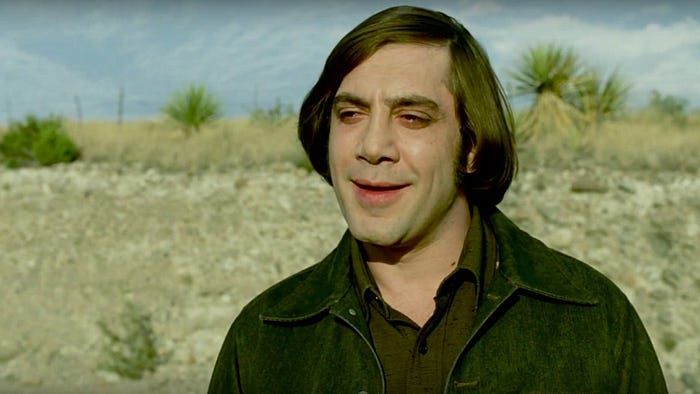
Here, the story world doesn't remain abstract or invisible. Instead, it takes on a mythic form in Anton Chigurh - the story world's law manifested as a human. He isn't a character in the conventional sense. He doesn't represent a competing set of values, and he can't be bargained with or defeated in the usual way. The best way to understand Anton Chigurh is as the story world's god incarnate: a deity of determinism who has come to enact its laws without exception.
When we look at him from this angle, the way he casually walks away at the end after having suffered an accident that leaves him severely injured makes perfect sense. He is not subject to the moral order of the story world he is its embodiment. The wounds are inconsequential, and so is the money, which he leaves behind. Why does he chase it in the first place? Not because it matters to him, but because it is an ordinary human incentive a mechanism he uses to set consequences in motion.
The Story World's Pattern of Consequence
In the world of No Country for Old Men, outcomes are not governed by intention, intelligence, or virtue. To survive, characters must accept that they can't control what happens next. They can only respond to events as they unfold, not act as if will or competence can shape the result. The harder they try to control outcomes, the more they seal their own fate.
This harsh truth — that you can't control outcomes — is established almost immediately. The film opens with Anton Chigurh being arrested by a deputy. At the station, the deputy updates his superior over the phone. Behind him, Chigurh calmly slips his cuffed hands under his legs, stands, and approaches.
The deputy ends the call by saying, "Yes, sir, I've got it under control". Those are the last words he ever speaks - they prove to be fatal. As he hangs up, Chigurh loops the manacles around his neck and strangles him on the office floor.
The flip side of the argument is established a few scenes later. If the deputy died because he claimed control, the gas station proprietor lives because he surrenders it.
The Coin Toss
After unsettling a gas station proprietor, Chigurh flips a coin and tells the man to call it. The man's life no longer depends on his hard work, his kindness, or his plans for the future. It depends entirely on a 50/50 toss.
Chigurh, as the "deity" of this story world, uses the coin toss as a test of whether a person will accept the story world's truth about control. He's effectively asking: Will you accept that outcomes are not authored by you, or will you insist that they are?
At first, the proprietor tries to understand what is at stake so he can make the right call, which amounts to trying to regain control. When he realises that understanding offers no leverage, he accepts the situation as it is and calls the coin. He passes the test and gets to live.
The coin toss is, in short, a ritual of revelation. He will use it once more in his encounter with the protagonist's wife, Carla Jean Moss, who refuses to call it. This scene makes very powerful use of dramatic irony. We the audience know that Chirgurh, despite his evil nature, does honour the coin's outcome.
That prior knowledge changes how we watch the scene. When Carla Jean pleads, "You don't have to do this", Chigurh replies with a statement of limits: he has given his word, and the consequence is already set. But as an act of "mercy", he offers her a coin toss because, in the logic he enforces, that is the only way a human being can be granted a chance to live without breaking the rule.
This is what makes the moment so cruel. We can see the escape hatch. We've already watched a man survive by calling the coin. So the tension in Carla Jean's scene isn't suspense about whether Chigurh will keep his word. It's suspense about whether Carla Jean will accept the only terms he recognises.
Her refusal reveals what the ritual is. To call the coin is not to gain control, but to accept that control is gone and that survival, if it comes at all, comes through submission to the world's terms. Carla Jean refuses to perform that submission. She refuses to treat her life as a game of heads or tails. In doing so, she rejects the story world's offer of "chance", and she pays for that rejection.
Carson Wells and the Illusion of Leverage
Another character who refuses to let go of the idea of control is Carson Wells.
Wells is a professional "cleaner" hired to recover the money. He is clever, experienced, and arrogant. He successfully tracks Moss to a hospital and even locates the hidden satchel of money. But he makes a fatal mistake: he chooses not to retrieve it immediately. He leaves it where it is, thinking he can use the knowledge of its location as a bargaining chip later.
When he returns to his hotel, he finds Chigurh waiting for him with a shotgun. Wells immediately tries to negotiate, offering the money in exchange for his life.
Chigurh's response is chillingly logical: "If you knew, you would have it with you."
Chigurh isn't calling Wells a liar. He's pointing out that Wells is operating under a delusion. In this world, "knowing" isn't about possessing information. It's about recognising when the time for influence has ended.
To Chigurh, if Wells truly "knew" where the money was in a way that mattered, it would be in his hands. By leaving the satchel behind to use as leverage, Wells was acting as if the outcome were still negotiable. He was behaving like an author who could still write a different ending. But Chigurh sees the "sequence" as already closed. By the time Wells sat down in that hotel room, his fate wasn't something to be discussed. It was something that had already happened.
The Satchel vs. The Coin
This is a variation of the same test we saw at the gas station:
The Proprietor realised that "understanding" the stakes wouldn't save him. He stopped asking questions and simply called the coin. He accepted the reality of the moment.
Wells clings to the belief that he can still "manage" the outcome. He treats the money like a chess piece he hasn't played yet.
By leaving the satchel behind, Wells acts as if the future is still negotiable. But in the "physics" of this film, once you are in Chigurh's sights, the time for negotiation has passed. The "sequence" is already in motion.
Chigurh's famous follow-up question makes this explicit: "If the rule you followed brought you to this, of what use was the rule?"
The "rule" Wells followed was the rule of Free Will the belief that you can prevent bad outcomes with intelligence and bargaining.
If he had truly "known", he would have taken the satchel with him. That would have been the equivalent of "calling it". There would have been no guarantee that Chigurh wouldn't kill him, but no guarantee that he would, either. By treating the satchel as leverage to be used later, Wells preserves the illusion that he has control. Instead, he ends up in a chair, facing a gun, with no coin-toss equivalent left to play.
Two Character Arcs
In my previous post, I talked about The Shawshank Redemption. These feel like two very different films, but they have surprisingly similar elements. Both stories are built around the same value opposition. In The Shawshank Redemption, assimilation aligns with determinism, and agency with free will. In both films, characters are faced with the same dilemma: do you treat the future as something you can bend through will, intelligence, and persistence, or as something you can only move through once events are in motion? The difference is that each story world rewards a different answer. The Shawshank Redemption is a world where commitment and patience can eventually carve a way out. No Country for Old Men is a world where competence can be real and still not be enough, because the chain of consequence doesn't negotiate. It is a world where Red's warning that "hope is a dangerous thing" is a literal law of survival, and where an Andy Dufresne would not have found redemption, only a literal dead end.
But the clearest similarity is structural. Both films have a protagonist and a deuteragonist, each with an arc of their own. And both open the same way: with the deuteragonist speaking from later, recounting what happened.
This technique does something very specific. It sets the audience's expectations before the plot even begins. It guides not only what we look for but also how we look at it.
Let's first look at Moss's arc.
Moss Character Arc
Moss has a negative arc. He starts out believing skill and nerve can control outcomes, and when he's offered exits, he turns them down.
He's introduced as self-reliant and highly competent. He hunts with care and precision, but even here the film slips in a quiet warning: his skill doesn't guarantee the result. He misses his shot.
His normal world fractures when he finds the money and the drugs - a situation whose scale and momentum outstrips the kind of problems his competence was built to solve.
What truly sets the chain in motion is his choice to go back with water. It's humane, but it also reveals the belief underneath his confidence: that he can still intervene, still change what's already in motion. That is the moment the hunt locks onto him.
From there, Moss survives long enough to make the illusion of control feel earned. He improvises, escapes, relocates, and adapts. Each narrow escape functions like evidence: if he stays smart and mobile, he can manage the ending.
Wells finds him in hospital after a direct encounter with Chigurh and is visibly impressed Moss is still alive. Wells offers him a way out: give up the money. Moss refuses. It is the closest thing he gets to "calling it".
After Wells is killed, Chigurh offers the same bargain over the phone: bring the money, and Carla Jean lives. Moss refuses again and doubles down. He tells Chigurh he's decided to make him "a project of mine".
Moss dies anyway. Not in a showdown, and not even on screen. He's killed by the cartel.
From a thematic perspective, Moss is the film's most persuasive case for the illusion of control. He earns his belief through action. He survives long enough for competence to look like leverage, and for the ending to feel negotiable. Without his arc, the film's thesis would feel simple-minded: that anyone who believes in control is just naïve.
And like Andy in The Shawshank Redemption, Moss becomes the catalyst for Bell's transformation, though in a very different way: not through inspiration or moral example, but by setting in motion a chain of events that forces Bell to confront the limits of his own belief system. In essence, Moss's downfall becomes Bell's reckoning.
Bell's Character Arc
We meet Bell in voice-over, speaking as someone whose faith in a certain order has already cracked. He used to believe the world could be understood, measured, and held in place by the right kind of person doing the right job. By the time he starts narrating, that belief has already begun to collapse.
The events that unfold show us what brought him fully to that point. Moss's choices set the chain of events in motion, and Chigurh embodies a kind of violence Bell cannot make sense of or bargain with. Bell keeps interpreting the case through his old model, as if it can still be contained and as if stopping it is still his responsibility. But again and again, he's simply too late, unable to change anything.
The key turning point in his arc comes with Bell's visit to Ellis, who puts it plainly to him: the world was never as orderly as Bell wanted to believe, and treating it as though it should be is vanity.
The resolution of his arc comes with the final dream he describes to Loretta. In the dream, Bell's father rides past him in the dark carrying fire in a horn, going on ahead to make a fire somewhere up in the mountains. Bell says he knew that when he got there, his father would be there.
Bell has stopped trying to be the person who holds the world in place. The dream gives him a different kind of orientation. Not control over what's coming, but the belief that there is still something worth following into the dark: continuity, care, and a light he doesn't have to create by force. It's Bell accepting limits without falling into despair.
Bell is introduced through his own narration of a worldview already in collapse, and that narration frames how we initially understand the events that follow. But the film does not limit us to Bell's perspective. We are shown far more than he ever sees. By following Chigurh directly, and by observing the patterns of consequence that unfold around him, the audience comes to understand the story world's moral logic in full.
As a result, when Ellis finally articulates that logic to Bell, the moment doesn't ask us to take Ellis at his word. We already know he's right. The tension lies not in whether the truth is valid, but in whether Bell can accept it. And, quietly and without triumph, he does.
No Country for Old Men is one of those films that leaves many frustrated and dissatisfied. We've been trained by a century of cinema to expect a final showdown a moment where the hero and the villain meet in the dust to decide who "deserves" to walk away. Instead, the protagonist dies off-screen, the villain limps away from a random car crash and out of the story, and the Sheriff retires to talk about a dream he had about his father.
On the surface, it feels like a narrative failure. But it's anything but. The film is a thematic masterclass, and once you look closely, every so-called "unsatisfying" choice reveals itself as a precise expression of the story's logic.
That lingering dissatisfaction is the point. We feel cheated because we want the world to make sense to reward effort, justify suffering, and deliver a clean ending. Instead, the film places us exactly where the characters are: confronted with a sequence of events that doesn't care about our expectations, our sense of justice, or our need for closure. In doing so, it forces us to experience the same helplessness first hand.